
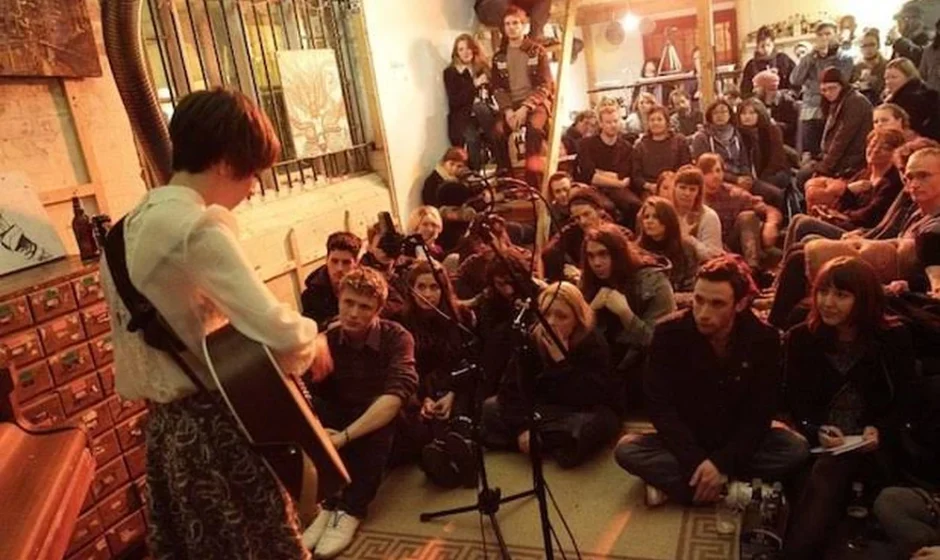

Twelve tables. That’s roughly how many people can ruin a great show in a small room, and I’ve watched it happen with four.
A songwriter with a guitar and no band behind him has nothing to hide behind. Every laugh, every beer bottle landing on a table, every phone lighting up goes straight into the room and into the recording of the night. The good news is that the crowd holds most of the power here. You can walk into a 120-seat venue and decide, on purpose, to be the kind of audience that makes a performer want to come back. Here’s how that works in practice, from the ticket page onward.
Why a Small Room Changes the Rules
In an arena, the crowd noise is part of the experience. In a listening room, the crowd is the fourth instrument, and it’s usually out of tune if nobody’s paying attention. Seating sits close to the stage, sightlines come with a dinner table attached, and the person next to you can hear your whisper at the back of the room.
Here’s the part that surprises people: this format isn’t new. Intimate folk and acoustic performance has deep roots in the United States. The Library of Congress has documented and archived folk music traditions for generations, and the house-concert model that grew out of those traditions is the direct ancestor of today’s small listening rooms. That history is worth knowing because it explains the expectations. Nobody invented quiet listening as a modern courtesy. It’s the format’s original contract.
Check the schedule with care, too. A room like McGonigel’s Mucky Duck upcoming events typically runs an early dinner show and a later set, which means the room has two completely different energies on the same night. Pick the one that matches your evening, not the other way around. My pick: the early show if you actually want to hear the lyrics, and the late set if you’re there to catch up with friends and treat the music as the backdrop. Both are legitimate. They just ask different things of you.
What the Room Wants From You: The Quiet Contract
I use one idea to organize everything in this piece: the quiet contract. It has five clauses, and every one of them is something you can break without noticing. I’d rather you memorize five short rules than read a lecture about respect.
- Phones stay dark. Down, silent, out of the sightline. A screen in a dim room is a flashlight pointed at the artist’s face.
- Talk only between songs. Even then, keep it short. A quick comment between numbers lands fine. A running conversation doesn’t.
- Sing along only if invited. Some artists ask for it and some don’t. Follow the cues from the stage rather than your own enthusiasm.
- Move during applause. Trips to the bar, the restroom, and the parking lot go between songs, not during the quiet verse.
- One drink order, one time. Settle in before the set starts so you’re not shuffling out of your seat all night.
The photo-and-video question comes up every time, and most small rooms handle it with a simple rule. If no policy is posted, watch the first song and follow the house. Better yet, ask at the door. Staff would rather answer ten questions than referee an audience.
Volume deserves its own note. If you’re chatting with a friend at a normal volume, the people three rows ahead can hear you better than they can hear the singer. That feels backward, and it’s just acoustics in a low-ceiling room. The Smithsonian Institution maintains collections and traveling exhibitions on American music history, and the material on small-venue performance is a good reminder that these rooms were built for listening, not for broadcasting.
The Seating Math Nobody Explains
Most intimate venues sell tickets as seats or tables, and a table is a shared object with rules of its own. If you’re a party of two, you might be seated with strangers. That’s not a snub. It’s how a room fills up. I’ve sat next to people who became regular show companions, so the arrangement has upside if you don’t fight it.
Here’s the planning step that actually changes your night. Arrive early enough to order and eat before the downbeat. In a room with a full dinner menu, the food is part of the ticket, and rushing a plate of hot food while the opener starts is the single most common rookie mistake I’ve seen. Give yourself a full hour.
How to Book Without Getting Burned
Small venues often make a specific choice about tickets: buy in advance, no refunds unless the show gets canceled. You’ll see that written plainly on most schedule pages. So treat the ticket like a concert, not a hangout plan. If you’re unsure about the date, wait to buy until you are. It costs you nothing to check the schedule twice, and it saves you from eating a ticket you can’t use.
| Your Situation | Best Move | What to Avoid |
|---|---|---|
| Want to hear every lyric | Book the early dinner show and arrive an hour early | Arriving at showtime with an empty stomach |
| Night out with friends | Take the late set and eat at your table | Treating the room like a bar with a band in it |
| Traveling from out of town | Buy in advance and confirm the seating type | Assuming you can swap the date later |
| Can’t make it in person | Ask about virtual or streaming options | Buying and then hoping to resell |
That last row matters more than people think. A growing number of small venues offer streaming tickets so you can support the artist from your couch. It’s a fine way to handle a date that collapses at the last minute, and a fine way to preview an artist before committing to a seat in the actual room.
Read the Room Like a Regular
Regulars at a small venue are easy to spot. They know the order of the night: doors, drinks, food, the set, the break, the second half. They know which table has the best sightline and where the servers walk. Most of all, they know when to stop talking. If you want to be treated like a regular, borrow those habits before you’ve been there five times.
The National Endowment for the Arts has long supported live music performance across the country, and small venues are where a lot of that support actually gets felt. You’re not just buying a ticket. You’re funding the room that keeps the touring artist in business.
One last habit worth building: don’t arrive determined to be the loudest fan in the room. Cheer loudly, sure. But between songs, keep your attention on the person with the instrument. They’re doing the hardest job in the building, and the room is small enough that your focus is visible to them.
Your Move
Intimate shows are the best deal in live music, provided you bring the right manners. Decide which set fits your night, arrive early enough to eat, keep the phone dark, and save your conversations for the applause. Then buy the ticket and show up ready.
Which part of the quiet contract will be hardest for you? Start there. Get that one right and the rest of the room will follow you.