
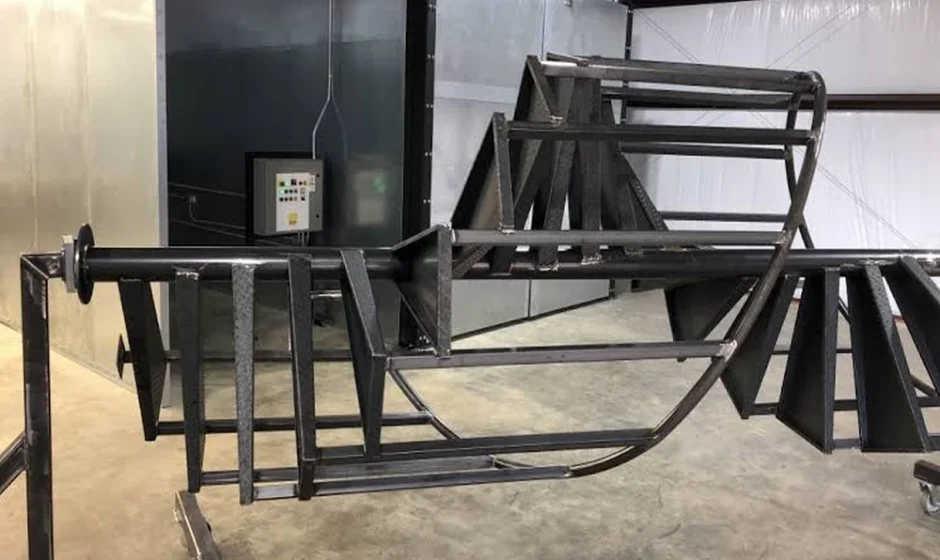

Rack spacing can change oven performance even when temperature settings, powder chemistry, and cycle time stay the same. Crowded loads restrict heated air, while excessive empty space can reduce the amount of work completed in each batch. Thoughtful spacing helps manufacturers find the point where airflow, cure consistency, and useful oven capacity work together instead of competing with one another.
Rack Spacing Controls How Heated Air Moves Through the Load
Heated air needs a clear path around parts, racks, fixtures, and chamber surfaces before it can transfer energy efficiently. Tightly packed panels or large flat components may act like barriers, redirecting circulation away from parts deeper in the load. Proper spacing inside Reliant powder coating ovens gives supply and return air more room to travel around each component, helping reduce temperature differences between exposed surfaces and sheltered areas. Manufacturers using powder coating equipment for batch work can gain more predictable curing by treating rack arrangement as part of the oven recipe rather than simply filling every available inch.
How Close Is Too Close for Parts Inside the Oven?
Clearance requirements depend on part geometry, rack design, airflow direction, and thermal mass, so there is no universal spacing number that suits every load. Broad sheet-metal panels may need more open space between faces because they can interrupt circulation, while smaller brackets may allow tighter loading without creating the same restriction.
Testing provides a better answer than visual judgment alone. Temperature probes placed on representative parts can show whether crowded areas consistently heat more slowly than pieces near the rack perimeter. Shops reviewing Reliant powder coating equipment for sale can use those results to establish practical rack patterns before deciding that slower batches automatically require more oven capacity.
Dense Loads Can Change Part-Metal Temperature
Batch density affects more than airflow because every additional piece of cold metal increases the amount of energy the oven must supply. Heavy fixtures, thick components, and closely loaded racks can lengthen heat-up time even if every part receives adequate circulation. Well-sized Reliant powder curing ovens help businesses handle those loads, but operators still need to recognize that doubling the number of parts can change the thermal behavior of the entire batch. Monitoring part-metal temperature gives production teams a clearer picture of when the slowest section actually enters the required cure range.
Orientation Matters as Much as the Distance Between Racks
Part position can determine whether heated air reaches important surfaces or simply flows around the outside of the load. Tall panels placed face-to-face may form narrow channels, while angled positioning can sometimes open a better route for circulation through the rack.
Rotation can also change which welded joints, recessed areas, or heavy sections receive the strongest airflow. A Reliant industrial powder coating oven may have enough heating capacity for the work, yet poor orientation can still create cold spots that extend cure time. Adjusting fixture angles can improve heat exposure without increasing temperature or purchasing larger equipment.
Standardized orientation becomes especially useful once a shop identifies a layout that works well. Documented patterns used with Reliant powder coating systems help different operators load recurring products in the same way instead of creating a new thermal arrangement every shift. Consistency also makes troubleshooting easier because supervisors can compare batches without wondering whether a completely different rack configuration caused the change.
Can Better Spacing Increase Throughput Instead of Reducing It?
Leaving more room between parts may seem like a loss of capacity, but tighter loading does not always produce more finished pieces per hour. Overloaded racks can take longer to heat, restrict airflow, increase cure uncertainty, and create rework that wipes out any advantage gained from carrying additional parts. Efficient use of Reliant powder coating equipment comes from measuring completed good parts per shift rather than counting how many pieces fit inside one batch. A slightly lighter rack that cures faster and more consistently can sometimes outperform a packed load with a longer cycle.
Repeatable Rack Layouts Make Cure Recipes More Reliable
Cure recipes work best when the load they were developed around stays reasonably consistent. Changing rack spacing alters exposed surface area, airflow paths, total metal weight, and the amount of energy required during recovery, which means the same oven setting may produce different results from one batch to another.
Recorded rack maps can remove much of that variation. Diagrams or photos showing part position, hook locations, spacing, and batch quantity give operators a repeatable reference for recurring work. Using those records with a Reliant powder coating equipment package can connect material handling, application, and curing practices instead of allowing each stage to develop its own unrelated setup.
Temperature history adds another useful layer because profiling a known rack configuration creates a baseline that supervisors can compare with future batches. Buyers considering a Reliant powder coating oven for sale can also use this information to determine whether current capacity is truly inadequate or whether inconsistent loading is causing the apparent slowdown.
Service Access and Door Clearance Belong in the Spacing Plan
Loading efficiency begins outside the hot zone because racks need enough room to approach the oven, clear the doors, and enter without scraping freshly coated surfaces. Oversized carts packed to their maximum width can slow loading and keep doors open longer, allowing more heat to escape before the cycle starts. Adequate clearance around rack edges also makes unloading safer once parts are hot and ready for cooling.
Reliant Finishing Systems can help shops think beyond the simple question of how many racks fit inside an oven. For manufacturers working with changing batch sizes or awkward part geometry, selecting oven and package dimensions around practical rack spacing can preserve airflow, loading access, and cure consistency while still making productive use of the chamber rather than turning every batch into a contest to see how much metal can be squeezed inside.