

You may have already heard that dental implants need enough bone to stay secure, then your dentist mentions your gums too, and suddenly the plan feels less simple than you expected. That reaction makes sense, especially for people exploring dental care in Floral Park. Most people think about the implant itself, not the soft tissue around it, until they learn that gum thickness can affect healing, appearance, comfort, and long term stability.
Before implant treatment, dentists look closely at the tissue covering the future implant site. Thin gums can be more prone to recession, metal show through, and irritation. Thicker gums often give better coverage and a more natural look, especially in visible areas like the front teeth. How dentists evaluate gum thickness before implant treatment comes down to a clinical exam, imaging, direct measurement when needed, and a treatment plan that fits what your mouth can actually support.
Gum thickness affects implant stability and appearance
When gum tissue is thin, small changes become easier to see. The edge of the gum can pull back, the contour around the implant can flatten, and the final crown may not blend well with nearby teeth. If the implant is placed in the smile zone, even a slight difference can bother you every time you look in the mirror.
There is also a health side to this. Thin tissue does not always mean implant failure, but it can raise the risk of inflammation, discomfort during brushing, and soft tissue recession over time. Research on peri implant soft tissue supports the idea that tissue thickness and width matter for long term tissue stability. A helpful review on peri implant soft tissue management explains how the quality and quantity of gum tissue can shape implant outcomes.
This is why your dentist does not just ask whether you want an implant. They study whether the site is ready for one, or whether the tissue needs support first.
Dentists use several methods to measure soft tissue before implants
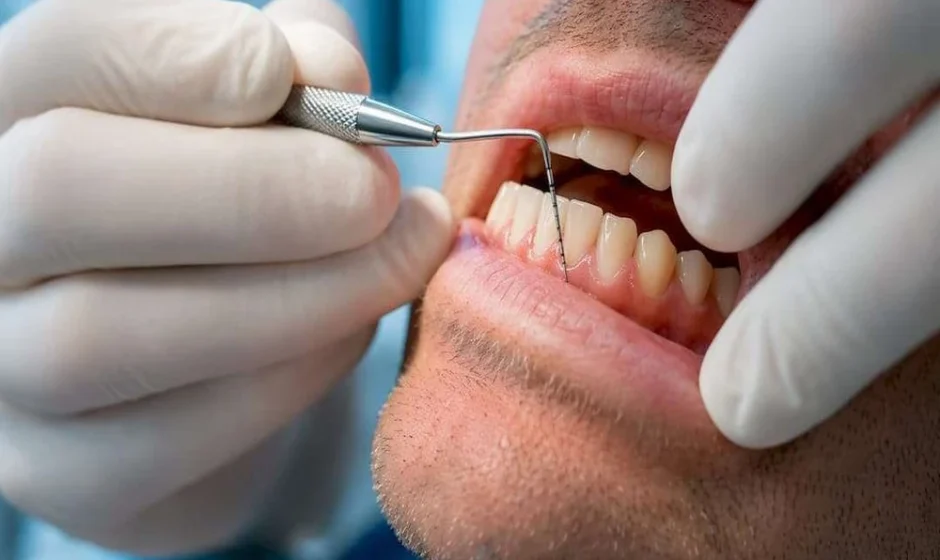
A basic visual exam tells part of the story. Your dentist looks at the color, contour, and firmness of the gums, checks for recession, and compares the site to nearby teeth. They also look at how much keratinized tissue is present. That is the tougher band of gum that handles brushing and daily function better than movable tissue.
Visual inspection is not enough on its own. In many cases, the dentist gently probes the area or measures tissue thickness directly. One common approach is transgingival probing, where a fine instrument is used to measure the soft tissue depth under local anesthesia. Some dentists also use ultrasound devices or CBCT scans paired with a clinical exam to estimate tissue dimensions without relying on guesswork.
Gum thickness assessment before dental implants often happens alongside bone evaluation because the two work together. A site may have enough bone for an implant but still need a tissue graft for better coverage. Another site may have decent gums but poor bone support, which changes the plan again.
Current research also looks at the reliability of different measurement methods. A recent study on gingival phenotype evaluation techniques reviews how clinicians assess soft tissue thickness and why accurate measurement matters when planning treatment.
Thin gums can change the treatment plan before implant placement
If your dentist finds thin tissue, that does not automatically stop treatment. It means the plan needs more care. In some cases, they may recommend a connective tissue graft before or during implant placement. In other cases, they may change the implant position, choose a different implant component, or delay the final crown until the tissue matures.
This part can feel frustrating, especially if you were hoping for a quick fix. You may be thinking, if the implant can go in, why not just place it now? The problem is that rushing through a weak soft tissue situation can create a result that looks off or becomes harder to maintain. Fixing recession around an implant later is usually more difficult than protecting the site from the start.
An implant dentist is looking beyond whether the implant will integrate with bone. They are also asking whether the gums will frame it well, stay healthy, and let you clean it without pain.
Comparison of common gum thickness evaluation methods
| Method | What It Shows | Advantages | Limits |
|---|---|---|---|
| Visual exam | General gum shape, color, recession, tissue quality | Fast, noninvasive, part of every consult | Cannot confirm exact thickness |
| Periodontal probing | Gum pocket depth and tissue condition | Helps detect inflammation and support levels | Does not directly measure tissue thickness |
| Transgingival measurement | Direct soft tissue thickness in millimeters | More precise for treatment planning | Usually needs local anesthesia |
| CBCT with clinical exam | Bone anatomy plus soft tissue context | Useful for full implant planning | Soft tissue detail is limited compared with direct measurement |
| Ultrasound or digital tissue analysis | Noninvasive soft tissue thickness estimate | Comfortable and repeatable | Not available in every office |
Clear steps help you prepare for implant treatment
Ask how your gum tissue is being measured. If your dentist says your gums are thin, ask what they used to determine that. A visual guess is not the same as a direct measurement. You want to know whether the site was assessed with probing, imaging, or another method.
Ask whether soft tissue grafting could improve the result. This matters most if the implant will be visible when you smile. A graft can add thickness, improve contour, and reduce the risk of future recession. It may add time and cost, but it can protect the final result.
Ask to see the full implant plan, not just the implant itself. The best plans include bone support, gum thickness, implant position, healing time, and the design of the final crown. This gives you a clearer picture of why your treatment is being staged a certain way.
Careful gum evaluation leads to better implant outcomes
The goal is not to make treatment sound more complicated than it needs to be. It is to avoid preventable problems. When your dentist checks gum thickness before placing an implant, they are trying to protect both function and appearance. That extra attention can mean fewer surprises, steadier healing, and a result that feels like it belongs in your mouth.
If you are considering implants, ask for a full soft tissue and bone evaluation before moving forward. A careful plan at the start gives you a stronger foundation for everything that follows.